 By
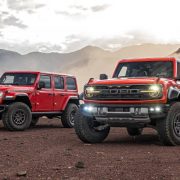
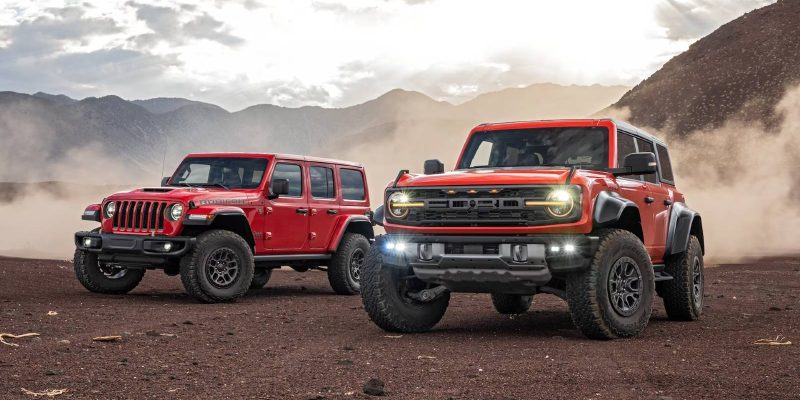
By A few years ago, Ford decided it was time to put an end to Jeep’s hegemony. The Blue Oval revived the legendary Bronco nameplate, and this comeback proved so resounding that the throne beneath the Wrangler began to shake precariously.
Buyers took notice, and today we are witnessing one of the most thrilling automotive duels in modern history. If you want to know how they compare in all parameters, check this Bronco vs. Wrangler overview by Autoland Jax used car dealer. And you want to dig deeper into their off-road capability, here are my first-hand impressions from a real off-road test drive.
Off-Road capability comparison: Forests, mud, and rocks
In dense forest environments, the Ford Bronco holds the advantage thanks to its shorter wheelbase, 100.4 inches versus the Wrangler’s 96.8 inches, which makes it more maneuverable among trees and on narrow trails.
However, the Jeep Wrangler, and I had a chance to get behind the wheel of the Rubicon Final Edition, surpasses its rival in terms of suspension articulation and geometry: an approach angle of 44 degrees, a departure angle of 37 degrees, and 10.9 inches of ground clearance allow it to confidently tackle large rocks and deep ruts.
On dirt, wet grass, and mud, both SUVs demonstrate consistent traction; however, the Jeep’s differential lockers engage more rapidly, especially in manual mode, which is a critical advantage in situations involving sudden wheel slip.
Suspension and drivetrain: The details that define potential
The Jeep Wrangler Rubicon comes equipped with the Rock-Trac system – a transfer case featuring a 4:1 low-range gear ratio and electronic locking front and rear differentials. The front stabilizer bar can be disconnected directly from the dashboard, allowing for up to 9.8 inches of suspension travel.
The Ford Bronco, in its Badlands trim, offers a similar system – G.O.A.T. Modes, featuring a 3.06:1 low-range gear ratio, locking front and rear differentials, and the ability to disconnect the stabilizer bar – a feature rarely found in production vehicles.
On rocky terrain, the Jeep operates with the precision of a fine instrument; however, thanks to its independent front suspension, the Bronco delivers a smoother ride at higher speeds.
Electronics and digital off-road assistance in Ford vs. Jeep
Both Jeep and Ford have invested heavily in off-road electronics. The Ford Bronco features a surround-view camera system with a forward-facing view mounted on the front bumper – an indispensable tool when navigating hilly terrain. Additionally, the Trail Turn Assist system allows the inside wheels to lock while off-roading, enabling the vehicle to pivot in place – an ideal feature for maneuvering in tight spaces.
The latest generation of the Jeep Wrangler introduces Selec-Speed Control – an off-road equivalent of cruise control that maintains a constant speed during ascents or descents without driver intervention.
Both SUVs allow users to record routes and real-time telemetry; however, the Wrangler’s interfaces are more intuitive and operate more quickly, even in areas with poor cellular coverage.
Operating Conditions: Mud, sand, snow, heat, and elevation changes
On loose sand, the Ford Bronco feels more sure-footed thanks to its independent front suspension and wider track width – 64.6 inches compared to the Wrangler’s 62.4 inches. This reduces the likelihood of the vehicle getting bogged down.
However, in deep snow and on terrain with steep elevation changes, the Jeep demonstrates superior traction distribution: its time-tested Command-Trac four-wheel-drive system reacts more quickly to changing grip conditions.
Extreme heat and high-altitude environments reveal another advantage of the Wrangler: its 2.0-liter turbocharged gasoline engine, equipped with an intercooler, is less susceptible to overheating.
The Bronco V6 EcoBoost features an efficient cooling system; however, owners in northern regions have reported slower warm-up times at idle.
Whether Ford or Jeep Breaks First: Practical insights from long-term testing
Mechanics at independent service centers and specialists in off-road vehicle customization note that the Jeep Wrangler retains its factory-level drivetrain reliability for up to 74,500 miles – even with regular driving in mountainous terrain and through water crossings.
The primary component at risk is the mechanical front-axle disconnect, which tends to operate less smoothly in freezing temperatures.
The Ford Bronco, on the other hand, is more prone to issues with the seals on its front headlight housings and underbody electrical connectors; while not critical, these issues do require additional protective measures.
The Bronco’s steering system proves more robust: its steering rack is more rigidly mounted, whereas the tie-rod studs on the Wrangler can loosen after frequent excursions over rough terrain.
Who wins the off-road showdown – Jeep Wrangler or Ford Bronco?
If we view the Jeep Wrangler vs. Ford Bronco off-road test as a purely practical exercise in survival – traversing rocks, wet forests, and mud – the Jeep Wrangler Rubicon emerges as the winner based on a combination of factors, ranging from its suspension to its overall reliability. It is a tool designed for those who engage in true off-roading.
The Ford Bronco offers a more pleasant driving experience, greater functionality for daily use, and an impressive level of technology; however, its true off-road potential is fully realized only after modifications.
For those seeking an all-in-one solution, the Bronco Badlands is the ideal choice. For enthusiasts of uncompromising, pure off-roading, the Wrangler Rubicon is the way to go.
Both SUVs command respect, but the true distinction lies in the nuances. Visit a car dealer near you to test drive both and choose your winner!